















Mental health symbols carry layered meanings shaped by culture, history, and lived experience. You’ll recognize the green ribbon as the universal sign of mental health awareness, representing renewal and recovery. The semicolon signals resilience and the choice to continue, while the butterfly mirrors transformation through struggle. Spiritual symbols like the medicine wheel emphasize holistic balance across mental, emotional, physical, and spiritual dimensions. Each symbol below reveals how communities worldwide express solidarity, healing, and hope. Exploring the concept of what symbol represents disorder can lead to important insights regarding stigma and misunderstanding in mental health. For instance, the jagged lines of the lightning bolt might evoke chaos and disruption, reflecting internal struggles faced by many.
Universal Mental Health Symbols: The Green Ribbon, Semicolon, and Bell

The green ribbon stands as one of the most widely recognized symbols for mental health awareness, with roots tracing back to campaigns launched in the 1990s. Inspired by the red ribbon’s success in HIV/AIDS advocacy, organizers selected green to represent harmony, renewal, and growth, qualities that reflect recovery’s possibility. You’ll find this symbol featured prominently during May’s Mental Health Awareness Month and October’s Mental Illness Awareness Week, where it drives global conversation and reduces stigma.
Beyond the green ribbon mental health awareness movement, the semicolon has emerged as a powerful symbol of continuation and resilience. It represents your choice to keep going despite psychological struggles. Together, these symbols function as cognitive anchors, helping you process complex emotional experiences while encouraging open dialogue and willingness to seek professional support. Institutions like Georgetown Behavioral Health Institute offer inpatient and outpatient mental health programs to help individuals take that critical next step from awareness to treatment.
Transformation Symbols Like the Butterfly and Lotus
When you examine transformation symbols in mental health contexts, the butterfly’s metamorphosis from caterpillar to winged adult offers you a powerful metaphor for the psychological journey through struggle, dormancy, and renewed growth. The lotus flower reinforces this theme by demonstrating that you can emerge from adverse conditions, much like muddy waters, with clarity and resilience, a concept deeply rooted in Buddhist and Hindu spiritual traditions. The different colors of the lotus further deepen its psychological symbolism, as the blue lotus specifically represents wisdom and knowledge that can guide individuals through their healing process. Similarly, the phoenix’s cyclical rebirth from its own ashes represents your capacity to reconstruct identity and purpose after experiencing psychological devastation, making these three symbols collectively meaningful frameworks for understanding mental health recovery.
Butterfly Transformation Journey
Among all transformation symbols used in mental health contexts, the butterfly stands out as perhaps the most universally recognized representation of personal change and renewal. When you examine its life cycle, egg, caterpillar, chrysalis, and adult, you’ll find a powerful symbol for mental illness recovery that mirrors the human healing journey.
The chrysalis stage particularly resonates with those facing psychological struggles, representing the difficult shift before emergence. You don’t simply endure this phase; you’re fundamentally restructuring your identity. This period mirrors shedding old patterns and confronting the shadow aspects of yourself that must be released before genuine healing can occur. The butterfly’s metamorphosis demonstrates that transformation isn’t a single event but a continuous process requiring patience and endurance. Monarch butterflies migrating thousands of miles reinforce this message of resilience against overwhelming odds. This symbol reminds you that profound beauty and strength can emerge from life’s most challenging periods.
Lotus Resilience Symbolism
Just as the butterfly’s chrysalis stage mirrors the hidden work of psychological healing, the lotus flower offers an equally compelling, and perhaps even more layered, symbol for mental illness recovery rooted in resilience. In lotus resilience symbolism, you’ll find a flower that emerges from murky water untainted, its radiance increasing proportionally with the mud’s depth.
This mental health icon symbolism resonates because it mirrors your psychological journey: adversity doesn’t contaminate you; it nourishes transformation. Understanding the social anxiety disorder diagnosis criteria can provide clarity for those grappling with their experiences. By recognizing the signs and symptoms, individuals can take proactive steps towards seeking help. This knowledge empowers you to embark on a path of healing and transformation.
- You rise from difficult conditions without losing your authentic self
- Your daily renewal cycles represent continuous capacity for overcoming challenges
- Each opening petal signifies incremental stages of personal transformation
- Your inner strength develops independently of external circumstances
- Challenging experiences provide essential nourishment for your growth
Across Hindu, Buddhist, Egyptian, and Chinese traditions, the lotus validates resilience as universally human.
Phoenix Rebirth Meaning
Transformation through destruction defines the phoenix’s enduring power as a symbol for mental illness recovery. You’ll find its cycle of fiery death and rebirth mirrors the psychological process of breaking down before rebuilding stronger. The phoenix symbolizes mental illness recovery because it reframes suffering as purification rather than defeat.
| Phoenix Element | Mental Health Parallel |
|---|---|
| Death in flames | Crisis or emotional breakdown |
| Ashes remaining | Vulnerability after struggle |
| Rebirth emerges | Recovery and renewed strength |
| Younger, stronger form | Post-traumatic growth |
| Eternal cycle | Ongoing resilience building |
You’re reminded that endings aren’t final but changes. The phoenix teaches that your greatest strength doesn’t come from avoiding hardship, it comes from rising after each fall, carrying forward an enduring essence that transcends temporary suffering.
Spiritual Mental Health Symbols From the Cross to the Medicine Wheel
When you look at spiritual symbols through a psychological lens, the cross and the medicine wheel both represent pathways toward inner wholeness that directly relate to mental health. The cross symbolizes the strength required to integrate both light and dark aspects of your psyche, a process that, while painful, leads to deeper self-awareness and resilience. Similarly, the medicine wheel positions you at its center to achieve balance across all dimensions of well-being, serving as a graphic reminder that harmony within yourself is both possible and worth pursuing.
Cross as Inner Strength
The cross stands as one of humanity’s oldest and most enduring symbols of inner strength, carrying psychological weight that extends far beyond its religious origins. From a Jungian perspective, the cross as inner strength represents a psychological stage where you’re integrating opposing forces within your totality of self. This visual representation mental health framework connects deeply with how mental health awareness symbols meaning functions across cultures.
- You can use the cross to anchor resilience during emotional distress, activating associative memory networks
- It serves among stigma awareness symbols mental illness communities recognize for continuity and hope
- The cross bridges ego consciousness with wholeness, representing psychological integration
- As advocacy symbols mental illness movements adopt, it communicates endurance beyond words
- It reminds you that suffering and strength coexist within the same symbolic framework
Medicine Wheel Balance
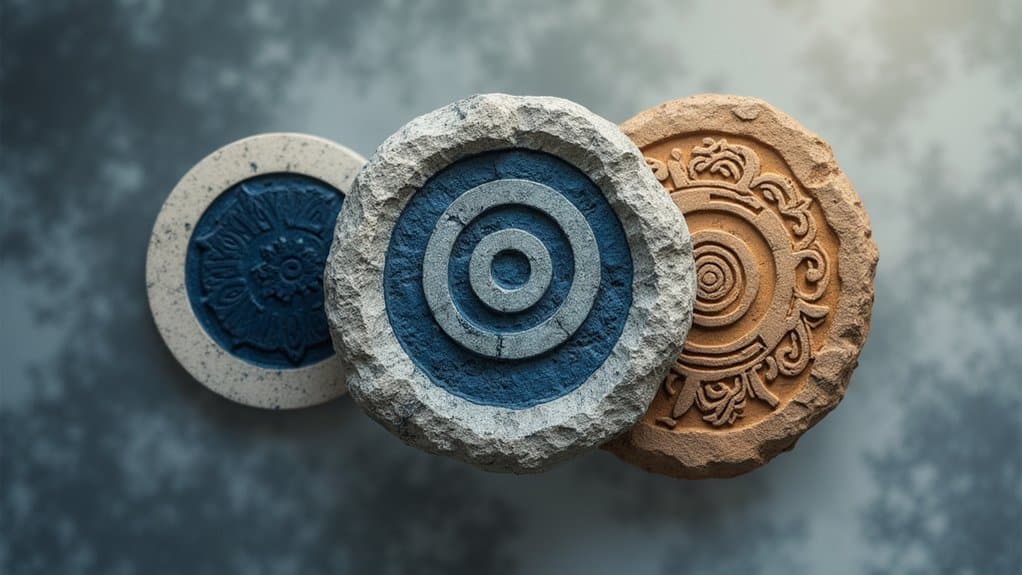
Moving from the cross’s vertical-horizontal integration of opposing forces, the medicine wheel offers an equally powerful but distinctly different framework for psychological balance, one rooted in circular rather than linear symbolism. You’ll find its four cardinal points map directly onto mental, physical, emotional, and spiritual dimensions of well-being.
Medicine wheel balance depends on continuous alignment among all four aspects. The East represents mental clarity, the South honors your physical body, the West invites emotional depth, and the North connects you to spiritual wisdom. When any quadrant falls out of harmony, psychological distress can follow.
Paralleling Jung’s mandala concept, the wheel functions as a cognitive anchor for individuation. It reminds you that healing isn’t linear, it’s cyclical, requiring ongoing attention to each dimension of your being.
Mental Illness Symbols in Japanese, Celtic, and Indigenous Cultures
Across Japanese society, where cultural emphasis on stoicism and emotional restraint has long made mental illness a taboo subject, visual subcultures have emerged as powerful alternative channels for psychological expression. The Menhera movement, derived from “mental health-er,” pairs kawaii aesthetics with clinical imagery to communicate the mental illness symbol meaning through fashion rather than words. This creative advocacy has prompted discussions surrounding the mental illness disorders list, highlighting the diverse range of conditions that often go unrecognized in mainstream conversations. As these visual cultures gain traction, they offer a crucial platform for understanding and destigmatizing various mental health challenges faced by individuals in Japan. Through art and fashion, the Menhera movement not only serves to raise awareness but also fosters a sense of community among those who share similar experiences.
You’ll find these subcultures serve dual functions, masking real suffering while simultaneously dismantling stigma:
- Menhera fashion incorporates pills, syringes, and bandages in pastel color schemes
- Yami-Kawaii (“dark-cute”) aesthetics normalize mental health dialogue publicly
- Jirai Kei acknowledges addiction and escapism themes within community spaces
- Symbolic accessories like wrist-slashing bracelets replace verbal disclosure
- Cynical text elements on clothing express distress without direct confrontation
These movements communicate that it’s okay not to be okay.
Modern Mental Health Symbols From Medusa to the Open Lock
While traditional symbols like the green ribbon continue anchoring mainstream mental health campaigns, a newer wave of visual icons has emerged from survivor communities and social media, redefining how people externalize psychological pain. You’ll find that these symbols function as cognitive anchors, helping you process abstract emotional experiences through concrete imagery.
The semicolon project symbol represents one of the most powerful examples, where a grammatical mark signifies choosing continuation over ending. It’s become central to suicide awareness efforts, appearing in tattoos and digital campaigns worldwide. Broken chains and light-emerging-from-darkness motifs similarly communicate liberation from psychological struggle.
These modern symbols activate associative memory networks, making them effective awareness tools. However, you shouldn’t treat symbolic representation as a substitute for clinical care, especially when you’re experiencing persistent withdrawal, mood changes, or functional difficulties.
The Mental Illness Flag and What Each Color Represents

The mental illness flag, introduced in 2020 by The Pete Foundation alongside over 100 mental health organizations in Louisville, represents one of the most deliberate efforts to create a unifying visual identity for psychological health advocacy. Its gradient design shifts from dark green to light yellow, symbolizing a sunrise’s change from darkness into light.
- Green base reflects the internationally recognized mental health awareness ribbon color, representing renewal and recovery.
- Yellow tones convey growth potential and healing energy associated with sunlight.
- Brushstroked texture guarantees cultural replicability and emotional accessibility.
- Color-coded advocacy ribbons address specific conditions, blue for depression, yellow for suicide prevention, purple for substance abuse.
- Global adoption spans all 50 states and multiple countries, reinforcing its transcultural reach.
You can display this flag to signal solidarity and reduce stigma.
Take the First Step Toward a Healthier Mind
Mental health challenges are hard to face alone but the right support can change everything. At National Mental Health Support, we connect you with licensed counselors who specialize in Trauma Therapy built around your needs. Serving individuals throughout Albany County and surrounding areas, our team is ready when you are. Call (844) 435-7104 today and take the first step toward a better life.
Frequently Asked Questions
Can Mental Health Symbols Be Used Effectively in Therapy or Counseling Sessions?
Yes, you can use mental health symbols effectively in therapy sessions. They function as cognitive anchors, helping you process abstract emotions like distress or hope. When you connect with culturally meaningful symbols, whether it’s a green ribbon, semicolon, or heritage-driven imagery, you’re activating associative memory networks that reinforce resilience. These symbols remind you that change is possible, providing grounding during vulnerable discussions. However, they’re most effective when complementing, not replacing, evidence-based clinical interventions.
Are Mental Health Symbols Trademarked or Free for Public Use?
Some mental health symbols are trademarked, so you can’t use them freely. Organizations like Mental Health America hold federal trademarks on specific logos and branding, requiring written permission and licensing fees for commercial use. SAMHSA’s official symbols are restricted to government use only. However, you’ll find that general symbols, like the green ribbon or semicolon, aren’t trademarked and remain widely available for personal and educational purposes. You should always verify usage rights before incorporating any symbol commercially.
Why Do People Choose Mental Health Symbols as Tattoos for Recovery?
You choose mental health symbols as tattoos because they serve as cognitive anchors that reinforce your recovery journey. Research shows visual symbols activate associative memory networks, helping you process complex emotions like resilience and hope. A semicolon tattoo, for example, represents your decision to continue despite struggles. You’re also reclaiming your narrative, transforming painful experiences into visible declarations of strength. These permanent reminders reduce internalized stigma and foster daily motivation toward healing.
Do Mental Health Symbols Differ in Meaning Across Different Age Groups?
Research suggests you’ll find that mental health symbols can carry different weight across age groups, though extensive data remains limited. You’re likely to notice younger generations gravitate toward symbols like the semicolon through digital culture, while older adults may connect more with traditional imagery like the green ribbon. Your generational context, shaped by cultural, economic, and social environments, influences how you interpret and emotionally respond to these symbols, though more targeted research is needed.
How Do Mental Health Symbols Help Reduce Stigma in Workplace Environments?
Mental health symbols help reduce workplace stigma by normalizing behavioral-health experiences and signaling organizational commitment to psychological safety. When you display emblems like the green ribbon, you’re creating visual conversation starters that break silence around mental illness. These symbols foster solidarity, helping employees recognize they’re not alone. They also encourage help-seeking behavior by reducing shame and isolation. Over time, symbol-driven awareness supports systemic cultural shifts that eliminate discriminatory attitudes and practices.