
















Starting in 2025, you’ll need to complete 45 hours of mandatory continuing education to maintain your nitrous oxide administration certification in mental healthcare settings. The updated requirements include 4 hours of self-study coursework, hands-on clinical training, and an 80% passing score on examinations. You’ll need current professional licensure, valid CPR certification, and medical clearance to qualify. Your training must cover emergency protocols, safety standards, and interdisciplinary collaboration. These extensive changes reflect evolving best practices in therapeutic nitrous oxide applications.
Regulatory Framework and State Requirements
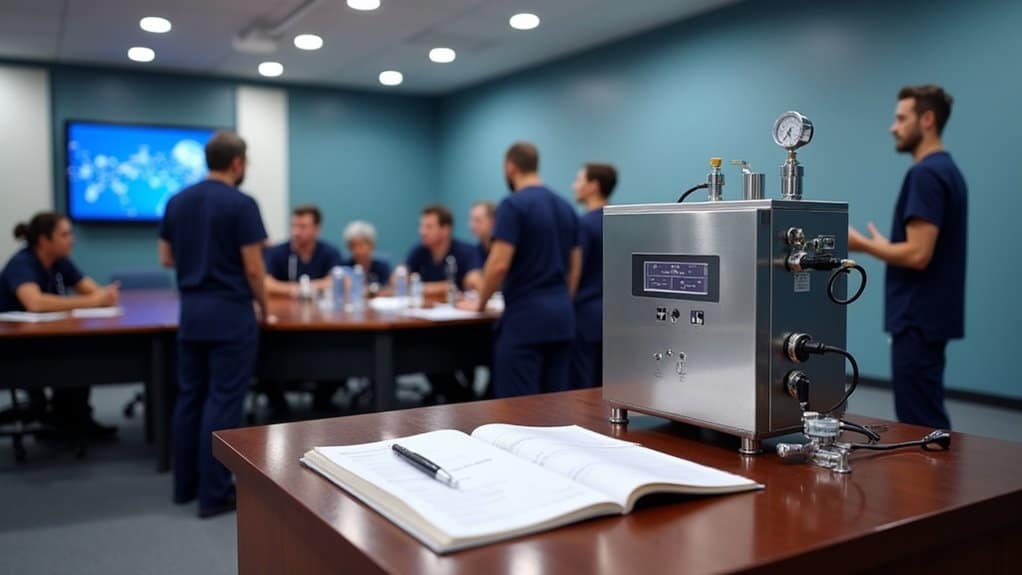
How do states regulate nitrous oxide administration in mental healthcare settings? States like Indiana, Minnesota, Florida, and Georgia have established thorough frameworks requiring certification under direct supervision. You’ll need to meet specific licensing eligibility criteria, including graduation from CODA-accredited programs or equivalent experience. Those seeking certification must show minimum experience requirements of at least one year in clinical practice.
The regulations emphasize structured training programs with qualified instructors qualifications and adherence to ADA guidelines. These programs integrate both didactic and clinical components, ensuring you’re competent in safe administration practices. All programs must include training on best clinical practices that support optimal patient outcomes and safety. Minnesota’s model requires 12 hours of training, while Florida and Georgia mandate home-study components with certification testing. The comprehensive training includes pre-clinical coursework that must be completed between specific dates before hands-on sessions. OSHA workplace safety guidelines are woven into state protocols, requiring ongoing monitoring and documentation. You must complete time-bound preclinical assignments and demonstrate proficiency through pre- and post-testing to maintain authorization.
Clinical Training Components and Timeline
Building on the state regulatory frameworks, the clinical training components for nitrous oxide administration follow a structured timeline designed to optimize learning outcomes. You’ll need to complete 4 hours of self-study coursework before advancing to hands-on training. Patient consent requirements are integrated throughout the learning modules, ensuring you understand proper documentation protocols. The curriculum draws from extensive clinical expertise, as demonstrated by instructors like Dr. Flamer-Caldera, who has provided nitrous oxide sedation instruction. The training emphasizes creating a safe environment, drawing from Ford’s workplace principles of fostering respectful and secure conditions. During the afternoon session, participants engage in clinical practice from 1:00 pm to 4:00 pm.
| Training Phase | Timeline and Requirements |
|---|---|
| Self-Study | 4 hours pre-clinical work |
| Video Modules | 3 hours technical training |
| Case Studies | Complete before clinical phase |
| Clinical Practice | Supervised administration |
| Certification | Final assessment required |
The 2025 scheduling logistics vary by location. Minnesota’s program splits preclinical and clinical sessions across October-November, while Charlotte’s workshop combines didactic and hands-on training in January. You’ll participate in peer experience sessions to better understand patient perspectives during sedation.
Certification Pathways for Healthcare Professionals

While traversing the certification process for nitrous oxide administration, healthcare professionals must satisfy multiple eligibility criteria and complete structured educational pathways. You’ll need current professional licensure, valid CPR certification, and medical clearance to both administer and receive nitrous oxide.
Professional development pathways include blended learning options combining online modules with hands-on clinical training. Your career advancement opportunities expand through state-specific programs, ranging from 45-hour extensive courses to shorter CEU-based certifications. You’ll need to achieve an 80% passing score on examinations to earn your completion certificate. You’ll encounter varying formats personalized to your jurisdiction’s requirements, with programs starting at $150.
State dental boards mandate specific compliance measures, particularly in New York and Arkansas. Your certification remains valid for 1-2 years, requiring ongoing CEUs and periodic recertification to maintain your credentials in mental healthcare settings.
Safety Protocols and Risk Management
You’ll need to master both emergency response procedures and equipment maintenance standards to guarantee safe nitrous oxide administration in mental healthcare settings. Your emergency response toolkit must include validated protocols for respiratory depression, psychotic episodes, and cardiac events, along with regular team drills to maintain readiness. Studies show that 50% nitrous oxide mixtures during one-hour sessions demonstrate significant therapeutic benefits for treatment-resistant depression. Providers must comply with state certification requirements for off-label administration of nitrous oxide in mental health contexts. Staff must be trained to carefully monitor and maintain oxygen saturation at ≥2% from baseline. Your daily equipment checks should verify scavenging system efficiency, gas mixture accuracy, and delivery system integrity, with documented maintenance logs that meet 2025 regulatory requirements.
Emergency Response Procedures
Establishing sturdy emergency response procedures serves as the cornerstone of safe nitrous oxide administration in mental healthcare settings. You’ll need to monitor vital signs continuously, with particular attention to oxygen saturation levels and carbon dioxide through capnography. When appraising patient eligibility criteria, evaluate medication contraindications through thorough psychiatric and neurological screenings. Pre-procedure screening requires patients to be at least 3 years old to ensure respiratory safety. With a 533% increase in calls to poison control centers regarding recreational use since 2019, healthcare providers must maintain heightened vigilance during administration.
You must act swiftly if oxygen saturation drops ≥2% from baseline or if patients exhibit signs of hypoxia. Immediately discontinue N2O, administer supplemental oxygen, and guarantee airway patency. Train your staff to recognize emergency indicators and implement rapid response protocols for cardiovascular or respiratory complications. Document all interventions in your EHR system and maintain clear communication channels between team members during emergencies.
Equipment Maintenance Standards
Beyond sturdy emergency protocols, proper equipment maintenance forms the foundation of safe nitrous oxide administration. You’ll need to conduct regular storage audits to safeguard cylinders remain secured in fire-rated areas with temperatures between 32°F and 125°F. Your daily checklist must include demand-flow regulation checks, interface testing, and validation of automated safeguards. Integrating pressure-demand respirators for personnel safety during maintenance procedures is essential.
The system requires 50/50 mixture ratios for optimal patient safety during procedures. Implement a resilient inventory reconciliation system to track cylinder usage, expiration dates, and supplier records. You’re required to maintain detailed documentation of all calibration dates, repairs, and system validations. Guarantee your scavenging equipment undergoes regular cleaning and leak detection testing to maintain NFPA 99 compliance. Remember to verify pressure sensors, oxygen ratio monitors, and emergency shut-off systems during each pre-use inspection to ensure excellent performance and patient safety.
Mental Health Applications and Treatment Protocols

Three major breakthroughs have revolutionized nitrous oxide’s role in mental health treatment: its rapid therapeutic onset, unique neurobiological pathways, and demonstrated efficacy in treatment-resistant conditions.
You’ll find that nitrous oxide’s 20% response rate in treatment-resistant depression represents a significant advancement, particularly when considering patient satisfaction metrics. The treatment works through SK2 potassium channel inhibition, bypassing traditional antidepressant pathways and offering hope for previously unresponsive patients. When administering the standard 25-50% nitrous/oxygen mixture, you must carefully weigh ethical considerations against therapeutic benefits. Regular monitoring of vitamin B12 levels is essential to prevent neurological complications and psychological disturbances.
Clinical protocols require 1-hour sessions with continuous essential monitoring, typically scheduled weekly. You’ll observe rapid symptom improvement within hours, with effects lasting up to two weeks, making this a promising option for acute mental health intervention.
Military-Specific Training Requirements
Military healthcare providers pursuing nitrous oxide certification must complete a rigorous four-day program that’s exclusively available to active-duty personnel. Under Commander Katiana Cruet‘s direction, you’ll gain combat readiness integration skills through specialized training that meets Navy Medicine’s continuing education standards for dental professional qualifications.
Military dental providers receive specialized combat-ready nitrous oxide training through an exclusive program directed by Commander Cruet.
The program emphasizes critical military-specific components:
- Hands-on clinical practice with supervised N2O/O2 administration in high-stress environments
- Management of acute anxiety and pain scenarios unique to military populations
- Implementation of standardized monitoring protocols across military dental facilities
You’ll need to demonstrate proficiency in both theoretical knowledge and practical applications before seeking privileges at your local military facility. This thorough approach guarantees you’re prepared to deliver safe, effective minimal sedation care while maintaining operational readiness in diverse military healthcare settings.
Alternative Pain Management Integration
You’ll uncover that integrating non-pharmacological anxiety control techniques with nitrous oxide administration creates a more extensive treatment approach for patients experiencing chronic pain and mental health challenges. Your implementation of mindfulness-based pain reduction strategies, when combined with N2O protocols, can greatly enhance treatment outcomes as evidenced by Southeast Health Group’s 56% improvement rate in quality of life measures. By incorporating these integrative treatment protocols into your continuing education requirements, you’ll develop a stronger foundation for delivering evidence-based care that addresses both immediate pain management needs and long-term therapeutic goals.
Non-Pharmacological Anxiety Control
While nitrous oxide remains a valuable tool in mental healthcare, practitioners must recognize and integrate evidence-based non-pharmacological anxiety control methods into their treatment protocols. You’ll find that combining cognitive behavioral interventions with body-oriented techniques offers extensive anxiety management solutions. Understanding how yoga-based anxiety reduction and biofeedback-enhanced self-regulation work alongside traditional treatments bolsters your therapeutic toolkit.
- Implement multicomponent interventions that blend breathing retraining, guided imagery, and cognitive restructuring
- Utilize technology-enhanced delivery methods to support patient adherence through hybrid models
- Integrate body-oriented techniques with structured psychotherapy to increase treatment effectiveness
These evidence-based approaches complement nitrous oxide administration while providing patients with sustainable anxiety management strategies they can use independently. When properly implemented, these methods dramatically enhance treatment outcomes and patient self-efficacy.
Mindfulness-Based Pain Reduction
Recent neuroscientific evidence demonstrates that mindfulness-based pain reduction offers a powerful complement to traditional anxiety management protocols. Understanding the neurobiological factors underlying mindfulness reveals distinct mechanisms from placebo effects, with heightened activation in executive control regions like the OFC and pgACC. You’ll find that trait mindfulness levels considerably influence pain perception outcomes.
| Training Duration | Neural Impact | Clinical Benefits |
|---|---|---|
| Single Session | ACC Activation | Acute Pain Relief |
| 4-Day Protocol | Executive Control | Reduced Intensity |
| MBSR (8 weeks) | Sensory Processing | Sustained Effects |
| 3-6 Months | Neural Plasticity | Functional Gains |
| 1000+ Hours | Prefrontal Deactivation | Amplified Modulation |
Research confirms mindfulness surpasses both placebo and relaxation techniques, demonstrating major reductions in pain intensity and unpleasantness that persist up to 52 weeks post-intervention.
Integrative Treatment Protocols
Integrative treatment protocols consistently demonstrate improved outcomes when N2O administration aligns strategically with alternative pain management modalities. You’ll need to consider metabolic imbalances and individual biomarkers when developing extensive treatment plans that incorporate N2O with other therapeutic approaches.
- Combine N2O sessions with breathwork techniques to enrich parasympathetic activation and optimize therapeutic benefits
- Implement functional medicine frameworks to address underlying metabolic imbalances before initiating N2O treatments
- Schedule N2O administration in coordination with other evidence-based therapies while monitoring crucial signs
Your treatment protocols must follow strict safety guidelines when combining N2O with other therapeutic agents. Real-time monitoring of crucial signs and post-treatment follow-ups are essential components of successful integrative protocols. Remember to document all interventions and outcomes to support ongoing research and protocol refinement.
Interdisciplinary Collaboration Standards
Successful interdisciplinary collaboration in mental healthcare requires an exhaustive framework that unites diverse stakeholders across multiple sectors. You’ll need to implement structured protocols that connect healthcare providers, emergency responders, and community organizations through coordinated community resource mapping and social determinant screening.
Your interdisciplinary standards must align with CLAS requirements while incorporating expertise from cultural and advocacy groups. You’re expected to facilitate seamless coordination between EDs, behavioral health specialists, and social service agencies. This means ensuring your staff receives cross-disciplinary training in crisis de-escalation, cultural competency, and technological literacy.
You’ll also need to establish clear channels for interagency coordination, particularly in developing unified platforms that support real-time communication between crisis response teams and community-based support services.
Recertification Guidelines and Compliance Updates
Professional recertification guidelines for nitrous oxide administration in mental healthcare settings have undergone significant updates for 2025, aligning with SAMHSA crisis response standards and state-specific renewal policies. You’ll need to comply with bolstered documentation policies and disciplinary enforcement measures that emphasize patient safety and practitioner accountability.
Updated 2025 nitrous oxide recertification rules align with SAMHSA standards, requiring stricter documentation and enhanced safety protocols in mental healthcare settings.
- Complete biennial renewal requirements, including passing the CDCA written exam with a minimum score of 75% and demonstrating practical proficiency in administration techniques
- Submit thorough documentation of physical/mental health conditions, substance use history, and any disciplinary actions affecting your practice
- Maintain detailed patient records covering dosage administration, monitoring protocols, and recovery status assessment
These guidelines guarantee you’re meeting both Maryland’s state requirements and SAMHSA’s 2025 crisis care standards while maintaining the highest level of patient care and professional competency.
Frequently Asked Questions
What Personal Protective Equipment Is Required When Administering Nitrous Oxide?
You’ll need several key pieces of protective equipment when administering nitrous oxide. Wear Viton, neoprene, or nitrile gloves for chemical protection, and use full-face pressure-demand respirators when concentrations exceed limits. Don goggles and face shields during potential exposure. Guarantee proper storage procedures in cool, ventilated areas and maintain appropriate ventilation requirements of 10 air changes per hour. Don’t forget to regularly check and maintain all PPE equipment.
Can Pregnant Healthcare Providers Participate in Nitrous Oxide Training Programs?
If you’re pregnant, you’ll need to carefully weigh participation in nitrous oxide training programs. While ethical concerns for providers emphasize your right to continue professional development, patient privacy considerations shouldn’t overshadow your health needs. Evidence suggests limiting direct exposure during pregnancy, so you should investigate alternative training options like virtual modules or observational learning. You’ll need to discuss specific accommodations with your employer and obtain proper medical clearance before participating.
How Are Emergency Situations Simulated During the Hands-On Training Sessions?
During hands-on training sessions, you’ll practice emergency scenarios using VR modules and fail-safe anesthesia equipment. You’ll learn critical skills like monitoring patient responsiveness through simulated cases of airway obstruction and laryngospasm. You’ll also gain experience managing equipment malfunction using interactive demonstrations and standardized checklists. Your instructor will monitor your performance while you work through multiple clinical scenarios, providing real-time feedback on your emergency response techniques.
What Happens if a Trainee Fails the Clinical Competency Assessment?
If you fail your clinical competency assessment, you’ll need to complete mandatory retraining before getting retake opportunities. You’ll work under direct supervision while addressing specific skill gaps through refresher courses. You’re restricted to basic procedures during this remediation period. You’ll need to demonstrate improved proficiency through documented case reviews and simulation training. Only after successfully completing clinical retraining can you attempt the assessment again.
Are There Age Restrictions for Patients Receiving Nitrous Oxide Treatment?
Yes, you’ll need to follow strict life stage-based dosage guidelines when administering nitrous oxide. Children under 2 years typically can’t receive treatment due to cognitive limitations, while patient screening protocols become especially critical for adolescents, given rising misuse risks. You must exercise supplementary caution with developmentally immature patients, who’ll require specialized conscious sedation techniques. For psychiatric patients, you’ll need to carefully evaluate mental health comorbidities before proceeding with treatment.